
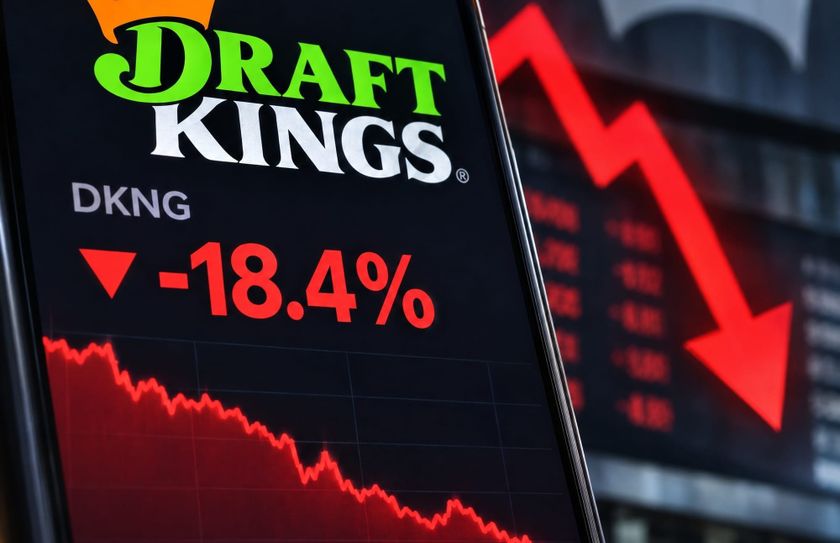
DraftKings stock suffered one of its worst single-day declines in company history on Friday, plunging approximately 27% after the sportsbook operator released its third-quarter earnings report and delivered a disappointing outlook for the next two years.
But the selloff wasn't really about a disappointing quarter. It was about the increasingly expensive battle taking shape between traditional sportsbooks and the rapidly growing prediction market industry....
DraftKings Is Spending Hundreds of Millions to Fight Prediction Markets
On the surface, DraftKings' latest earnings report wasn't entirely bad news. Third-quarter revenue increased 16% year-over-year to $1.33 billion, while monthly unique paying customers increased 13% to 4.1 million. Sports consumer volume also increased 22%. The problem is profitability. DraftKings reported an adjusted EBITDA loss of $316.9 million during the quarter, compared to a loss of $126.5 million during the same period last year. More importantly, management dramatically reduced its full-year 2026 adjusted EBITDA guidance from $700–900 million to just $175–275 million.
The primary reason? A massive investment in its Predictions business.
DraftKings now expects to spend between $650 million and $700 million on its prediction market operations in 2026, including $175–225 million in the fourth quarter alone. The company is attempting to compete directly with established prediction market operators like Kalshi and Polymarket, which have attracted considerable attention and trading activity.
The investment is significant enough that DraftKings expects promotions and customer acquisition costs to offset most of the revenue generated by Predictions this year.
Investors weren't particularly enthusiastic about that prospect.
The company's initial 2027 outlook didn't help matters. DraftKings expects adjusted EBITDA of $800 million to $1 billion next year, considerably below the approximately $1.12 billion analysts had anticipated.
In other words, DraftKings is growing its customer base and generating more revenue, but the price of competing in this evolving market is eating into the profitability investors were expecting.
The Problem Extends Beyond DraftKings
Flutter Entertainment, the parent company of FanDuel, has also acknowledged increasing competitive pressures from prediction markets. Its latest earnings report highlighted rising media acquisition costs and investments in improving its own prediction market capabilities.
For years, the traditional sportsbook business model benefited from an expanding legal market, increasing customer adoption and relatively strong opportunities to acquire new customers. Few foresaw the challenge and threat that would be posed by platforms like Kalshi and Polymarket.
Prediction markets also operated under a different regulatory framework, creating an increasingly complicated competitive landscape for state-licensed sportsbooks that must navigate gaming taxes, licensing fees and state-specific regulations.
The result is a potentially expensive competitive disadvantage for traditional operators. DraftKings is effectively being forced to invest hundreds of millions of dollars to make sure it doesn't lose relevance in a market it helped establish.
What Does This Mean for the Future of Sports Betting?
Prediction markets represent an existential threat to traditional sportsbooks. If consumers increasingly migrate toward event-contract exchanges, established operators could face slower handle growth, higher customer acquisition costs and declining margins.
DraftKings' 27% stock decline is a warning that the sports betting industry's growth story is becoming considerably more complicated, and the days when DraftKings and FanDuel could focus primarily on expanding their sportsbook businesses may be coming to an end.
They now have to defend those businesses against competitors operating under a different regulatory structure, with different economics and increasingly substantial financial resources.
For sports bettors, this could eventually mean more competition for customers, more products to choose from and potentially more aggressive promotional offers.
For investors, however, the immediate question is whether the enormous cost of keeping up with prediction markets will ultimately generate enough new business to justify the investment.